
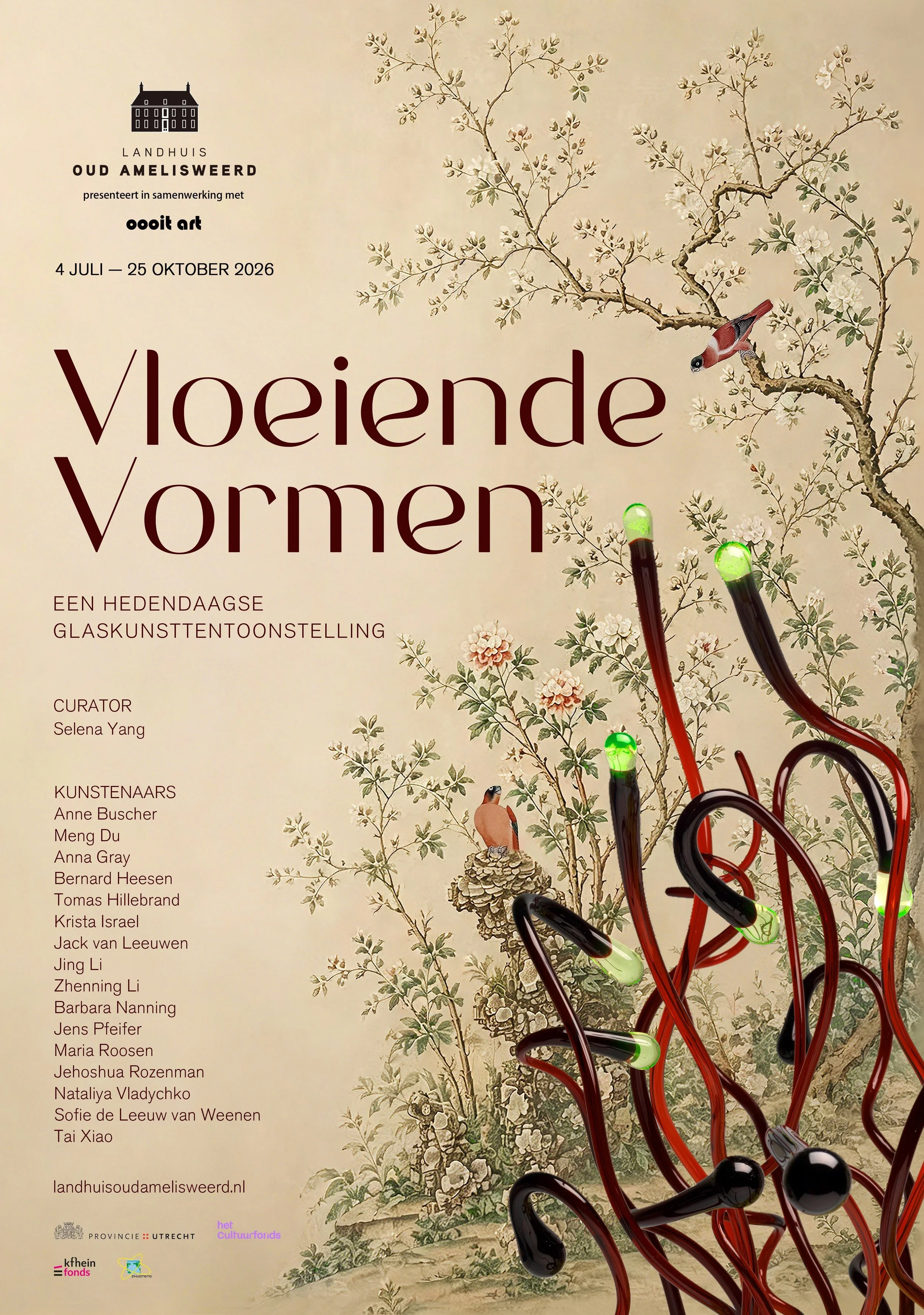
Group Exhibition: Flowing Forms
July 4–October 25, 2026
Landhuis Oud Amelisweerd, the Netherlands
Curator: Selena Yang
Artists: Anne Buscher, Meng Du, Anna Gray, Bernard Heesen, Tomas Hillebrand, Krista Israel, Jack van Leeuwen, Jing Li, Zhenning Li, Barbara Nanning, Jens Pfeifer, Maria Roosen, Jehoshua Rozenman, Nataliya Vladychko, Sofie de Leeuw van Weenen, Tai Xiao
Culture has never been static.
Like nature, it flows, transforms, and grows.
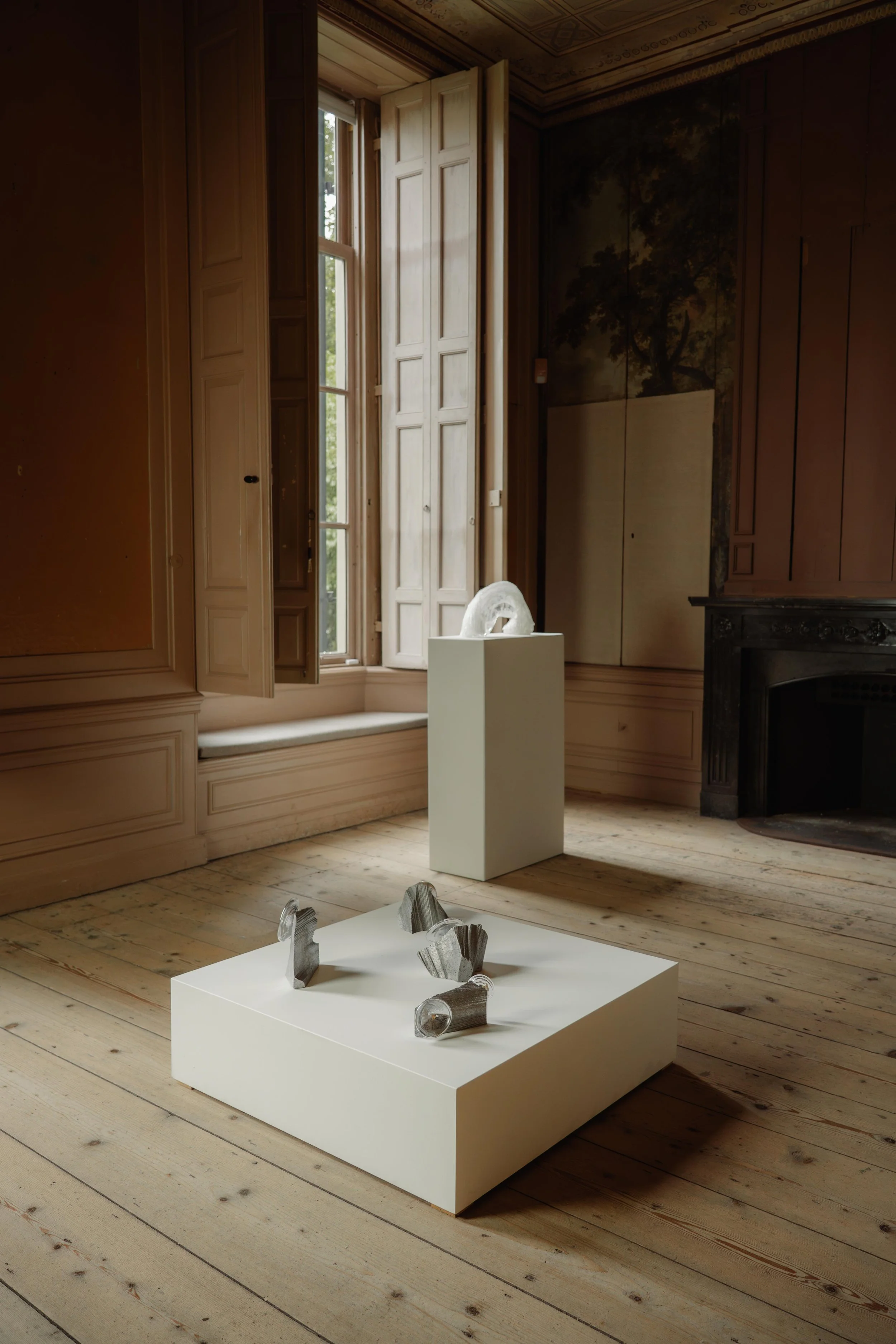
Flowing Forms explores how contemporary glass art reflects the fluid and living nature of culture. The exhibition takes place in the wallpaper rooms of Landhuis Oud Amelisweerd, alongside Europe’s best-preserved collection of Chinese hand-painted wallpapers from the Qing Dynasty, an exceptional testament to centuries of cultural exchange. The exhibition reveals how images, craft techniques, and ideas continuously travel through time and space. Glass itself, fragile yet enduring, becomes a perfect metaphor for migration, renewal, and the connections between tradition, nature, and our shifting sense of belonging.
Taking this historical resonance as its point of departure, Flowing Forms investigates how contemporary glass art embodies the same sense of movement, vulnerability, and ongoing transformation. Once molten and glowing hot, now solid yet endlessly reshapeable, glass carries within it the story of how materials and meanings migrate across time and space. From ancient beads and stained-glass windows to experimental sculptures and site-specific installations, glass reflects a world in constant motion.
The sixteen Dutch and international artists employ a wide range of traditional and innovative techniques, including glassblowing, kiln casting, fusing, coldworking (cutting, engraving, sandblasting), lamination, and light projection. Many works incorporate natural elements and references to the cultural heritage of the estate, creating layered dialogues between interior and exterior, nature and culture, past and present.
Within the historic rooms where Chinese hand-painted wallpapers meet Dutch architectural heritage, these glass artworks open new conversations about identity, memory, and the tension between local traditions and global exchange. They invite us to reflect on the fragile balance between what we choose to preserve and how culture — like nature itself — continues to grow, transform, and renew itself.
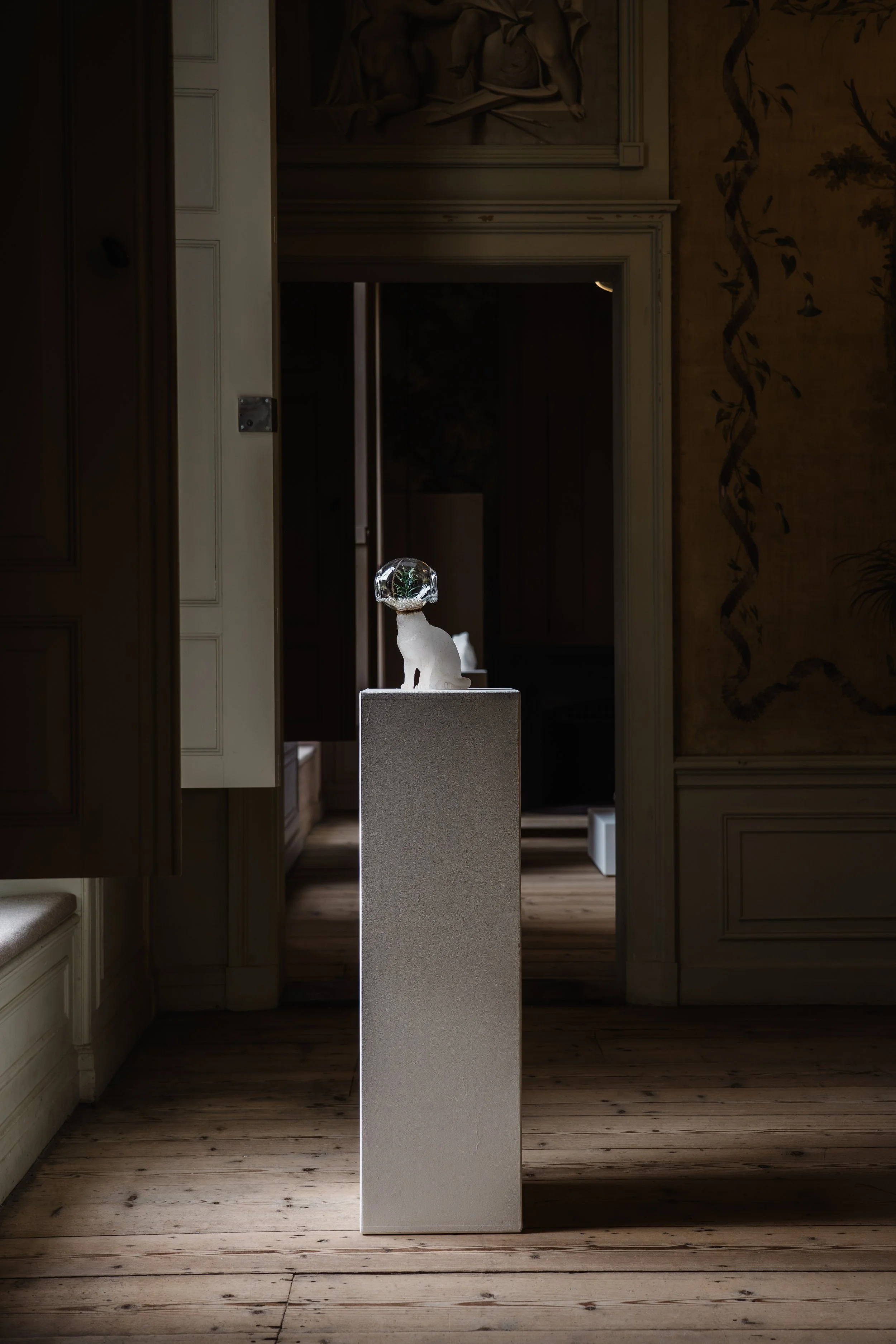
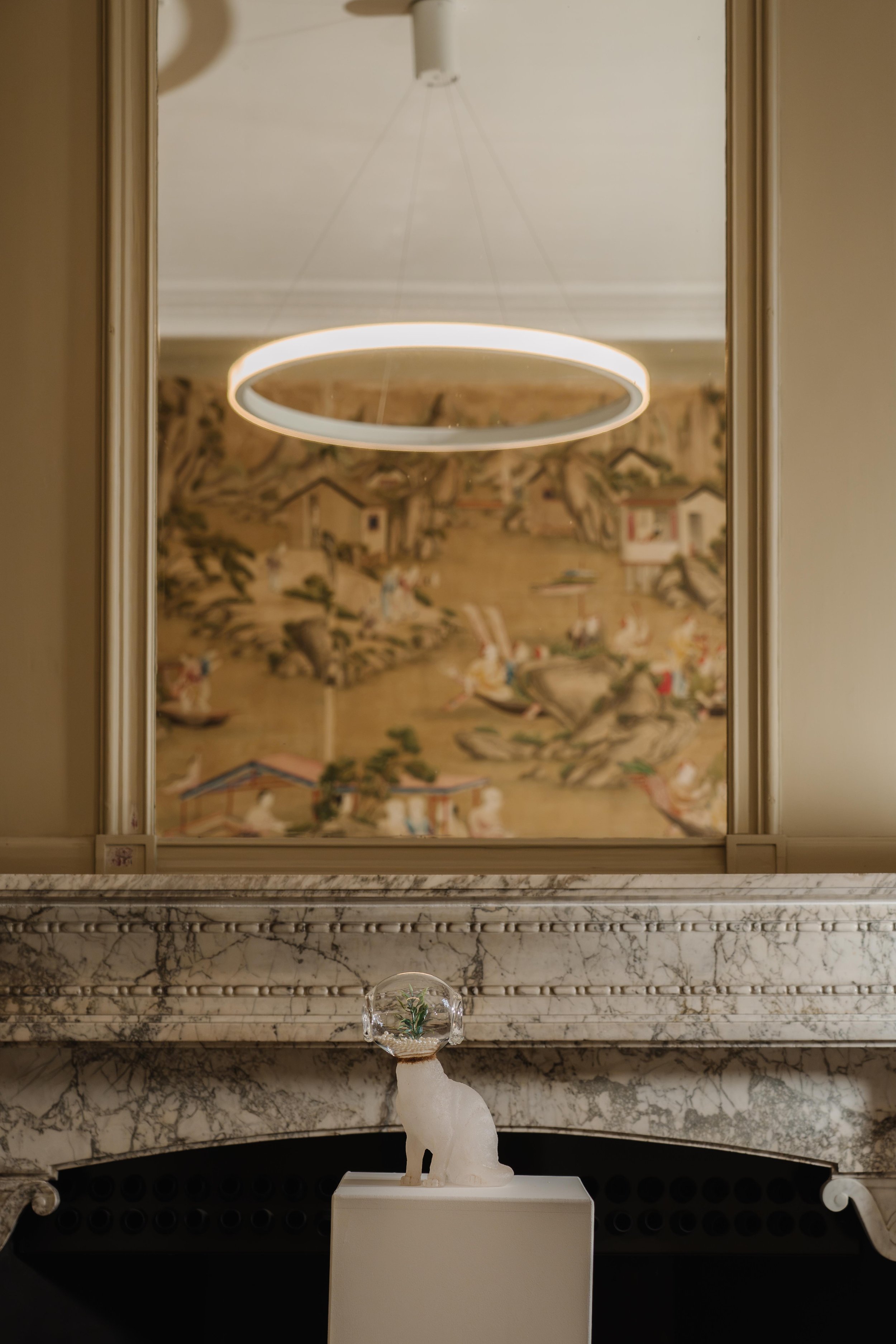
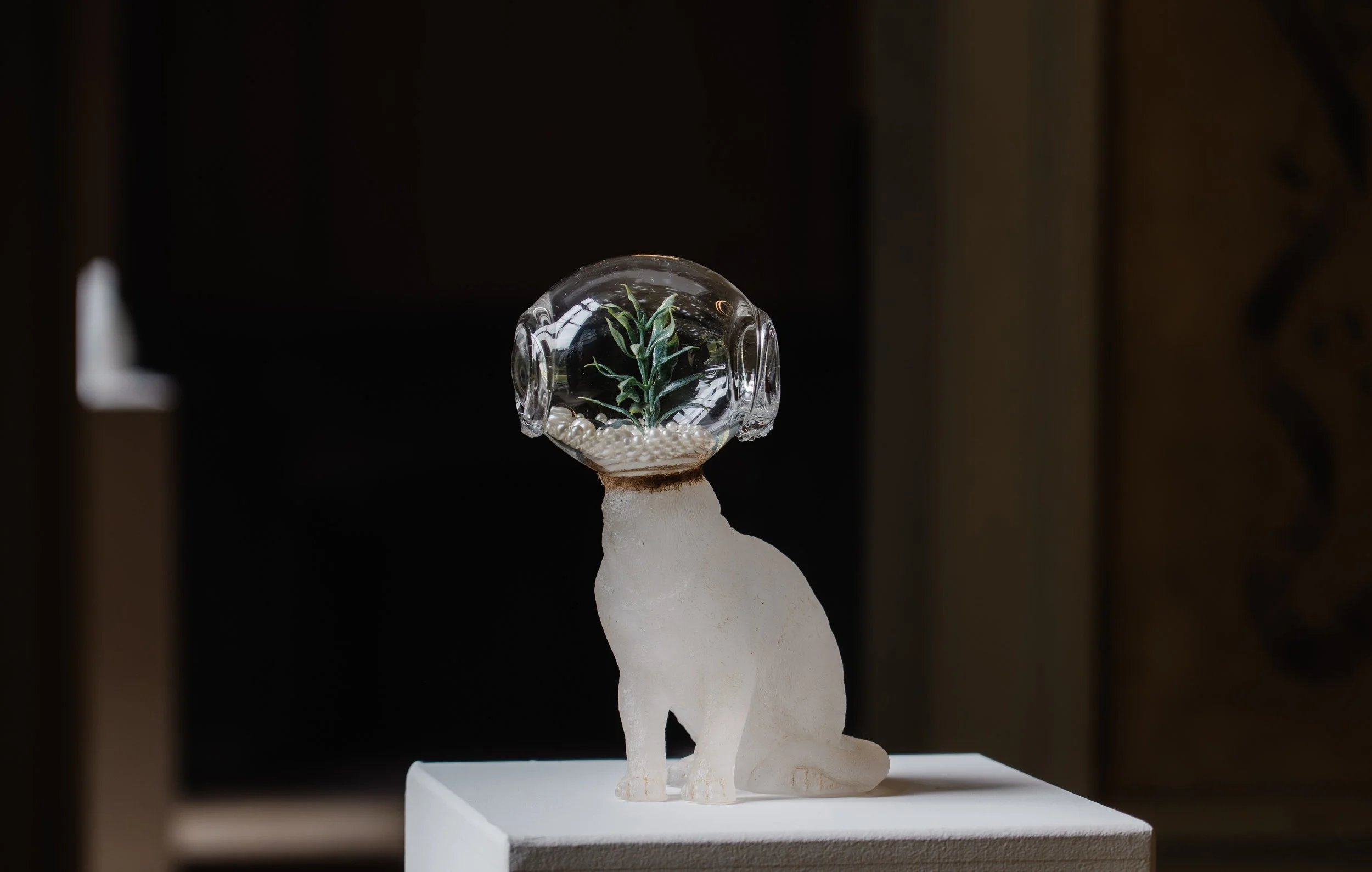
Meng Du’s The Cat in the Corner comes from daily life, and also embodies the artist’s personal memories and journeys. Meng Du has two cats accompanying her through a long journey from a glass apprentice to a professional artist, from Beijing, to Rochester, U.S.A., and then back to Beijing. They have become inseparable companions in her life, and witnesses to the four seasons. In the past year, although the space we live in is limited under the pandemic, the world in her heart has gone through the changes of four seasons with cats and plants, infinitely extended beyond the window. The artist imagines four cats separately in the corners of the room, looking at each other while keeping a distance, with a delicate balance of intimacy and freedom. Each cat is created with a different technique, combining glass casting and glassblowing techniques, and dyed with tea, and carries a nostalgic atmosphere. The cycle of life is constantly moving forward, and the desire for peace is constantly superimposed. Another edition is currently in the collection of Victoria & Albert Museum (London).
About Landhuis Oude Amelisweerd
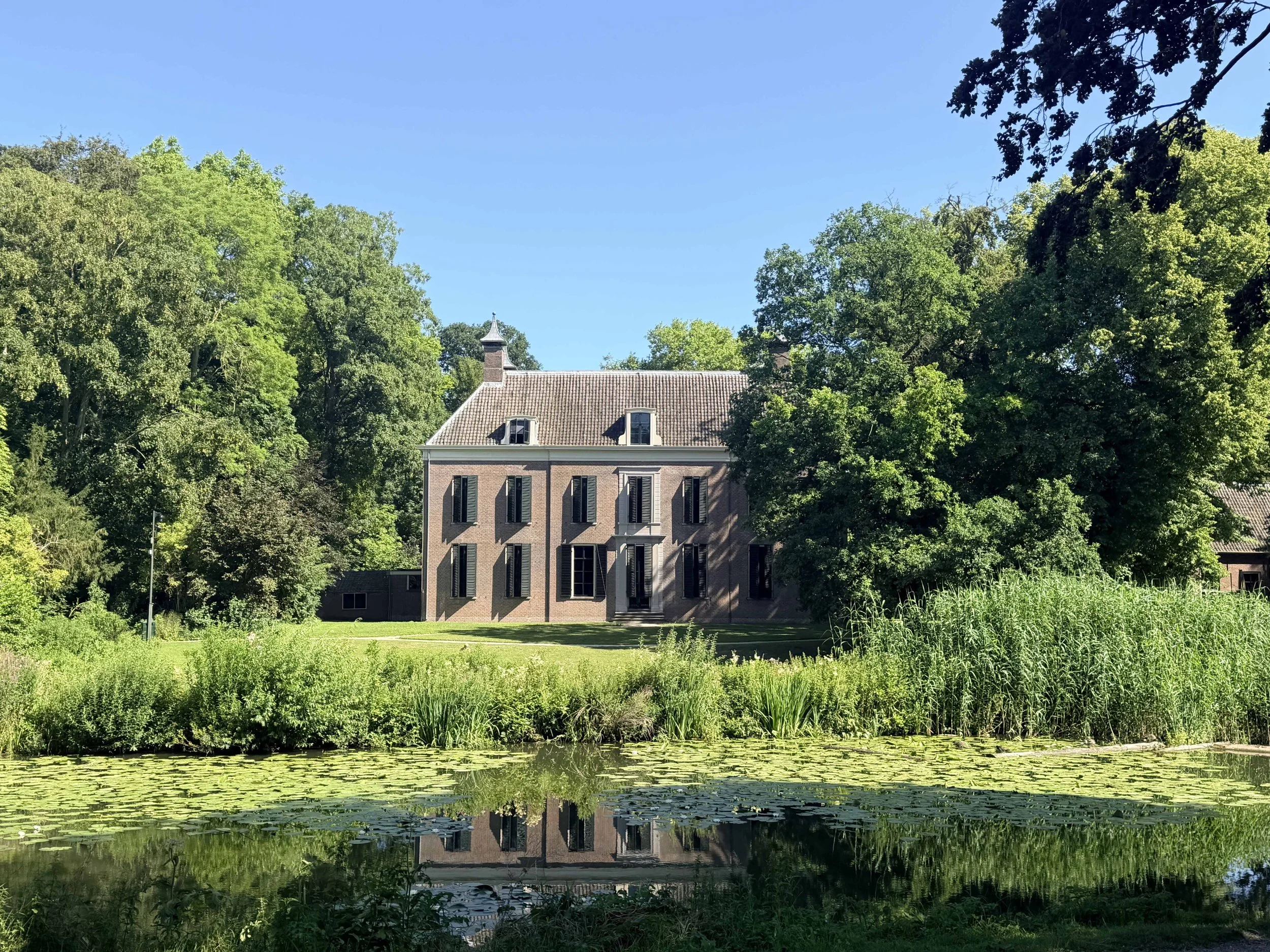
The museum estate was built in 1770 as a summer residence, commissioned by Gerard Godard Taets van Amerongen. At the same time, he redesigned the entire surrounding landscape, laying the foundation for today’s forest park and natural environment.
Over the centuries, the estate has witnessed a rich and layered history. It was successively associated with several influential figures and families, including Louis Napoleon Bonaparte and the Bosch van Drakestein family. Since 1951, it has been managed by the Municipality of Utrecht. Since the 18th century, this historic monument has preserved much of its original spatial layout, wooden floors, doors, windows, and ceiling ornaments. Of exceptional significance are the authentic Chinese hand-painted wallpapers from the 18th and 19th centuries, preserved alongside traditional Dutch wall coverings that remain intact within the house today. This rare historical integrity makes the estate one of the Netherlands’ valuable cultural heritage sites.
Today, the museum holds a distinctive position within the Dutch contemporary art landscape. In collaboration with cultural institutions such as the Centraal Museum Utrecht, as well as artists and curators, the museum develops exhibitions and cultural programmes that foster dialogue between cultural heritage, nature, and contemporary art.
About Oooit Art
Oooit Art is an independent platform for contemporary art and cultural exchange based in Utrecht, the Netherlands. The platform is dedicated to connecting artists and cultural institutions while supporting the development of contemporary art through an international and interdisciplinary perspective. Oooit Art focuses on the exchange and connection between Eastern and Western cultures, exploring how art can create spaces for encounter, reflection, and cultural dialogue. In collaboration with artists, museums, and public spaces, Oooit Art develops exhibitions, publications, and cultural projects in which tradition and contemporary practices meet within new contexts.